Measurement reference · FaceFluent editorial · September 13, 2026
Upper lip share of lower third
Of the distance from the base of the nose to the chin, the share taken up above the mouth opening. The convention puts it at about a third.
Educational method only. Personal numerical values are currently unavailable in the free preview and reports under the current offer. Existing purchases retain their purchased scope.
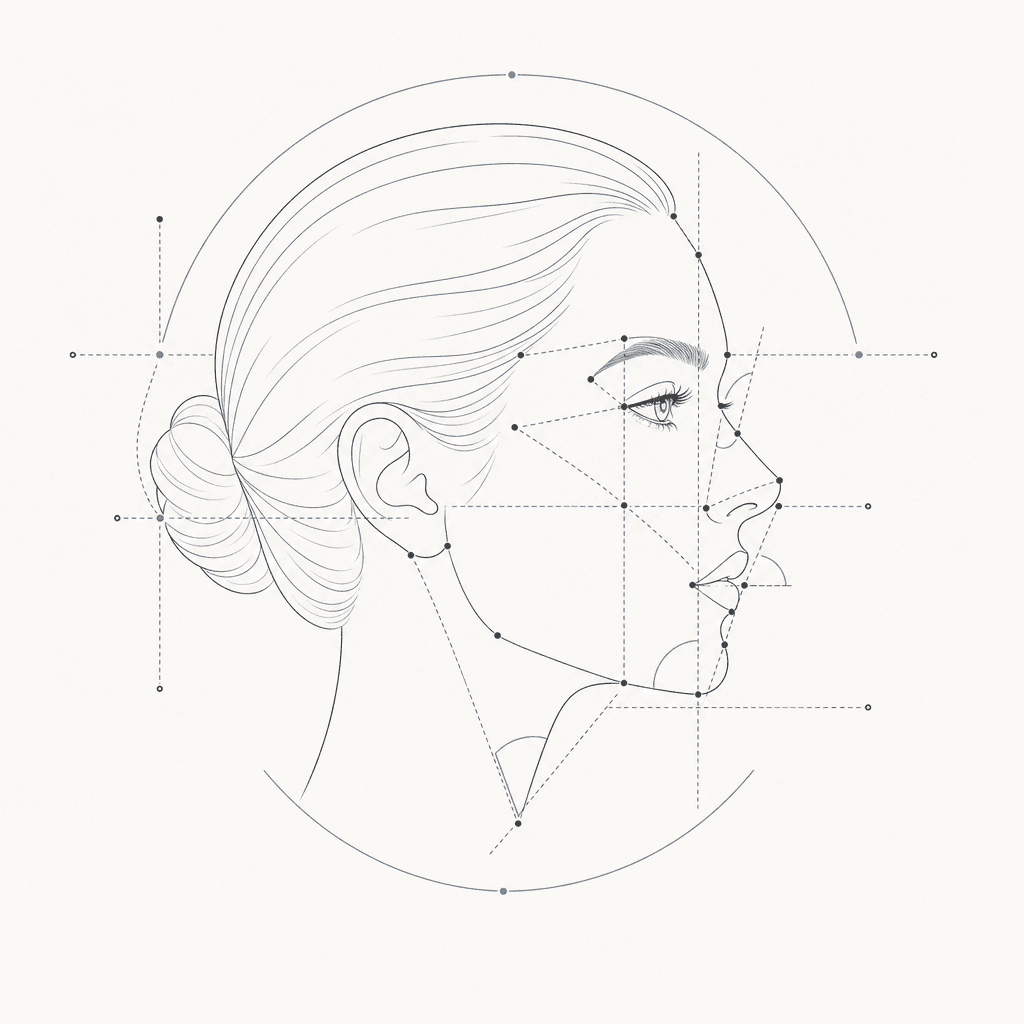
Also called upper lip share of the lower third, facial thirds.
Reference range
None.
Historical drawing canons provide context for this proportion. We do not display a numerical target band or treat those canons as population norms.
How we calculate it
The vertical gap from the base of the nose down to the mouth line, divided by the whole distance from the base of the nose to the chin.
What moves the number
Jaw position and lip posture. An open or tense mouth shifts the mouth line and therefore the ratio.
What it cannot tell you
Farkas found the vertical canons to be the least often met of all the ones he tested. The historical one-third convention is a habit of illustration, not a validated target for our scanner.
Common questions
What are the facial thirds?
A drawing convention that divides the face into three vertical parts — hairline to brow, brow to the base of the nose, and the base of the nose to the chin — and treats them as roughly equal. It is a construction aid for artists, not a measurement of how faces are actually distributed.
Should my facial thirds be equal?
There is no should. Farkas tested the vertical canons against real measurements and found them the least often met of all the ones he examined, so equal thirds describe a habit of illustration rather than a typical face.
Can facial thirds be changed?
The proportion this page describes shifts with jaw position and lip posture, which is to say it moves with how you are holding your face in the photograph. Anything beyond that is a medical question and belongs with a qualified clinician, not with a styling tool.
References
Some familiar facial proportions come from artistic conventions. Their history does not make them universal targets.
Read: Facial thirds and drawing conventionsTry a haircut on your photo. On-device landmark annotations are optional and stay in this browser.
Try a haircut on my photo Try free face analysis on your deviceThis page is educational. It is not a clinical assessment, a diagnosis, or a claim about how you look. Read the methods and limitations.